
La Sylphide

...
After the French Revolution of 1789, the system of financial support for European ballet all but disappeared. During the first twenty years of the 19th century no important ballets were produced in France. La Sylphide marks the beginning of a new era.
La Sylphide is the declaration of a new and innovative generation of defiant artists: the Romantics. Dissatisfied with the reality of their time, they sought shelter from the oppressive and anonymous atmosphere of the Industrial Revolution in a world of dreams.
The Romantic ballets differed from preceding ones because they were inspired by recent literature, and no longer by classical mythology. The story was contemporary, set in 1830. Adolphe Nourrit (1802 - 1839) based the libretto on the novel Trilby or the Lutin d’Argail by Charles Nodier (1780 - 1844), a renowned Romantic author. Nourrit himself suggested that Filippo Taglioni should create a ballet based on the story.
La Sylphide is the first ballet that expresses the Romantic philosophy fully: the hero, who is about to succumb to the status quo, forsakes everything to search for true happiness and avoid responsibilities. It introduces a vision of a lyric supernatural world, parallel to reality, inhabited by beings as impalpable as dreams. When the protagonist loses his dream, he is destined to die.
La Sylphide represents a revolution the history of ballet: for the first time, the ballerina rises on the tips of her toes in the pursuit of unnatural beauty and lightness, perfectly adapted to the role. The tutu, the diaphanous dress of the Sylph, set a style that has marked ballet for more than a century and is still considered the typical attire of the classical dancer in the popular imagination. The tutu was designed by Eugène Lamy, while the other costumes were by Lormier. With the introduction of the tutu, La Sylphide begins the series of the “ballets blancs” or white ballets that would be become the hallmark of the Romantic style.
The ballet choreographed by Filippo Taglioni (1777 - 1871) premiered March 12, 1832, at the Paris Opera; the music was composed by Jean Schneitzhoeffer. Joseph Mazilier interpreted the part of James and Marie Taglioni (1804 - 1884), the daughter of the choreographer, the Sylph.
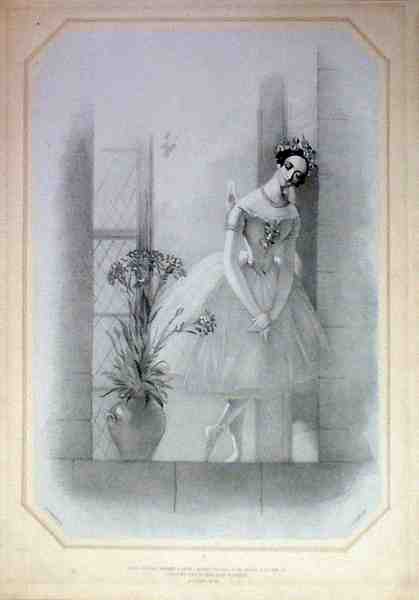 Marie Taglioni, born in Stockholm to an Italian father and a Swedish mother, became the greatest dancer of her time. Initially, she studied with her father, later she attended lessons at the Paris Opera while Filippo Taglioni was on tour, as leading dancer and choreographer of the Royal Danish Ballet. She made her debut in Vienna, in 1822, in one of her father’s ballets, although he did not yet consider her sufficiently prepared.
Delicate and ethereal, those who saw her were conquered by her sublime interpretation: the exact measure of the character, the feeling, the situation. She abandoned the stage in 1848, at age 44, for knee problems.
Support our site: shop at our store for dance-related books, DVDs, toys, gifts and more…
La Sylphide was represented at Covent Garden, London in July 1832, in Russia in 1837 and in Italy in the 1837 – 38 season.
August Bournonville (1805 - 1879) created his own version of La Sylphide in Copenhagen, entitled Sylfiden. August studied under his father Antoine Bournonville (1760 - 1843) who was the leading dancer of the Royal Danish Ballet from 1792; where he subsequently became ballet master. August was sent to Paris perfect his technique with Auguste Vestris and Pierre Gardel. He became the leading dancer of the Paris Opera from 1820 to 1828, with Marie Taglioni as his partner.
He returned to Denmark in 1829, as principal dancer and choreographer of the Royal Danish Ballet. He saw La Sylphide in Paris in 1834; two years later he created his own version, following the same outline and libretto Taglioni used. Bournonville’s version employed a new musical score by Hermann Severin von Lovenskjold. His favourite student, Lucile Grahn (1819 - 1907), interpreted the Sylph. Sylfiden premiered 28 November 1836.
Bournonville’s choreography is renowned for its exuberance, lightness, and formal beauty. He gives greater importance to the male dancer than other contemporary European choreographers. Sylfiden has remained uninterruptedly in the repertory of the Royal Danish Ballet and it is today the best-known version of the legendary ballet.
Taglioni’s La Sylphide was introduced in the United States in 1835; Bournonville’s was first seen there in 1956.
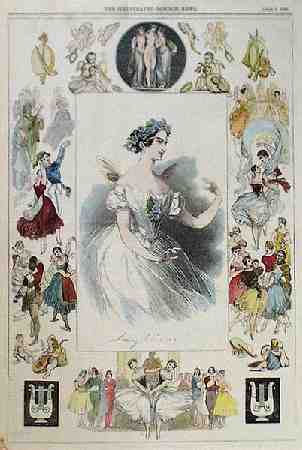 James, a Scottish peasant, is about to marry a peasant girl named Effie. A Sylph, a winged spirit of the forest, falls in love with him on his wedding day. She appears to James so that he, in turn, falls in love with her. He attempts to restrain her, but she escapes through the fireplace chimney.
Numerous friends enter with his fiancée Effie, and his mother. The old witch of the village, Madge, makes her appearance and predicts the girls’ futures. When she tells Effie that she will be happy in marriage, although James does not love her, he becomes infuriated and chases her away with a broom.
The Sylph returns and James declares his love to her. James doesn’t notice his friend Gurn, who is secretly in love with Effie, spying on him. Gurn runs to Effie and tells her what he has seen, but when he returns with James’s mother and his fiancée, James hides the Sylph under a blanket. Gurn sees that the blanket has changed position, but when he moves it there is nothing under it -- the Sylph has disappeared.
The wedding begins, but the Sylph appears to James again. He abandons his fiancée and their relatives and runs away with her.
Being mortal, James realises that it will be impossible to keep the Sylph. Madge, the witch, recognizes James’s difficulty and offers him a magical scarf that he must tie around the Sylph’s waist in order to restrain her. She tells him it will make her wings fall off, so she will not be able to fly anymore.
James’s dreams are crushed when he ties the scarf around her waist: the Sylph falls to the ground, lifeless. Other Sylphs manifest themselves and encircle her. She dies in their arms while James looks on dejectedly, powerless. The Sylphs raise her into the air and carry her away.
In the distance James sees wedding festivities: Effie has married Gurn.
Madge enters and James confronts her. He wants to murder her, but Madge strikes and kills him. The ballet concludes as Madge rejoices over her victory.
Testo: E. Meyer © 2003-18 Art & Dance Factory a.s.d.