
The Rite of Spring
The Rite of Spring is one if the most popular and revolutionary ballets of the 20th C. In music this masterpiece is considered the beginning of the Modernist movement, with its dissonances and audacious, fluctuating rhythms.
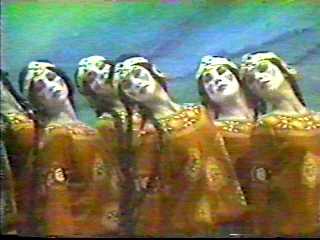
At the world premiere in Paris at the Champs-Elysees Theatre on March 29, 1913, it was in program with Les Sylphides choreographed by Michel Fokine (1880 – 1942).
The Rite of Spring caused a fracas: the shocking music and the audacious choreography created by Vaslav Nijinsky (1890 - 1950), provoked so many protests from the affluent audience that the dancers on stage couldn’t hear the nearby orchestra.
The crowd went from insult to injury attempting to physically assault the musicians and dancers. Maurice Ravel (1875 – 1937), who was applauding enthusiastically among the spectators was called a “dirty Hebrew”.
Despite the confusion, the show went on, pressed on by Nijinsky, the choreographer, who stood on a chair in the wings shouting instructions and miming the rhythm for the performers on stage.
Sergei Diaghilev (1872 – 1929), the director of the Ballets Russes had given instructions to the conductor Pierre Monteux (1875 – 1964) to “keep on playing at any cost”. The newspapers called the evening “The Massacre of Spring”. The reaction of the ballet community was mixed.
Igor Stravinsky (1882 – 1971) had studied with Nikolai Rimsky-Korsakov (1844 – 1908) in Russia; after moving to Paris he became acquainted with Debussy and Ravel. While he was finishing The Firebird, he had a vision of a solemn pagan ritual: ancient sages sat in a circle watching a young virgin dance until she died. He wanted to translate his vision into a symphonic poem to be titled The Great Sacrifice.
He spoke to his friend the painter Nicholas Roerich (1874 – 1947), an expert on pagan Slavic rites and rituals. Roerich collaborated with Stravinsky for the realization of the scenario for the ballet and also created the costumes and the stage set.
Diaghilev was immediately attracted to the idea and commissioned the composition, convinced that it would be perfect for a successful ballet for the next season, The Coronation of Spring. The name was changed to The Rite of Spring at the last minute.
Composing for such a vivid and primitive scenario made Stravinsky delve deeply into his imagination and the subconscious, refusing accepted musical styles as much as possible. Described as “Pictures of Pagan Russia”, it tells the story of a virgin, the Elect or Chosen Victim, who will be sacrificed to the God of Spring.
The ballet consists of two sections “The Adoration of the Earth” and “The Sacrifice”. The music has never lost its originality and freshness; it remains one of Stravinsky’s most popular works, both in the concert hall and on stage.
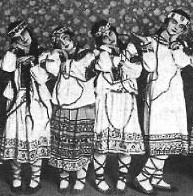
The irregularity of the music with its intense primordial rhythms suggests contorted positions, bends and jolts closer to the flowing natural movements of “free dance” created by Isadora Duncan (1878 – 1927) than to academic classical dance.
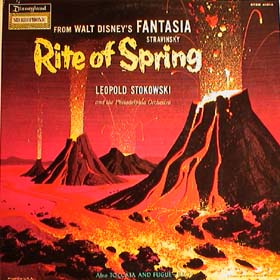
In Fantasia (1940), Walt Disney (1901 – 1966) created a virtual choreography showing the evolution of life on earth to the rhythm of the Rite of Spring.
Kenneth MacMillan (1929 – 1992) presented a transposition of the Rite of Spring with a man dancing the role of the Chosen Victim in 1962. Pina Bausch (1940 - ) explored the emotions and the terror of the participants dancing on a stage covered with earth, in 1975.
Nijinsky absorbed these sensations creating hard, primitive movements with the legs turned in, loose swinging arms, and the dancers' heads hanging to the side. The choreography was built of groups of dancers that formed masses on stage and executed simple natural movements.
Nijinsky’s version was only performed five times in Paris and three in London. The ballet caused the bankruptcy of the owner of the Champs-Elysees Theatre.
Over time the geniality of the work has been universally recognized and the ballet has become legendary. Nijinsky’s choreography was never staged again until Millicent Hodson recreated it for the Joffrey Ballet in 1987. Hodson based her choreography on research and interviews with Dame Marie Lambert (1888 – 1982), Nijinsky’s assistant while creating the Rite.
Countless choreographers have created hundreds of versions of the Rite of Spring. Among them: in 1920 Leonide Massine (1896 – 1979), financed by Coco Chanel (1883 – 1971), produced a remake of Nijinsky’s choreography in a more civilized version that emphasised the social relationships between the members of the tribe; Marta Graham (1894 – 1991) appeared in the role of the Chosen Victim in the first tour in the United States in 1930.
Support our site: shop at our store for dance-related books, CDs, DVDs, toys, gifts and more…
Maurice Béjart (1927 - ) in his renowned choreography for the 20th Century Ballet emphasized the reproductive power of sexual duality, presenting a company dressed in catsuits that made the dancers appear nude. In his ballet, the sexual act becomes the sacrifice. Béjart commented, ”Human love in its carnal aspects symbolizes the act with which God created the cosmos and the joy that derived from the creation.”
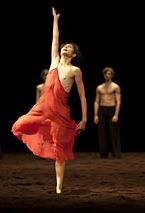
In 2002, Angelin Preljocaj (1956 - ) explored modern rituals of passion, tracing a dangerous trajectory of desire, where the embraces of young lovers become destructive as they seek out more and more extreme experiences.
Home